How can we get alongside our friends and family in need of support?
It’s World Mental Health Day today. And whilst we think about what services, hospitals, medication and therapy our friends, family and community need. Let us also remember that the number 1 suffering reported with mental illness is Loneliness.
Mental illness, a breakdown, grief or chronic periods of distress create a deeply disconnected and detached reality. Loneliness is a silent ‘epidemic’ and most people who have experienced this report the loss of key relationships, connections and community as a huge contribution to their worsening feelings of depression and hopelessness.
So on a day when we all need to think about how we tackle the issue of worsening mental health, I wanted to share just how important and valuable you can be for your community and your family if you can offer:
* A regular visit, a cup of tea and some of your time
* A trip to the beach, the forest, the riverside
* A walk, some exercise and time in nature
* An offer to go shopping together
* A couple of phone calls to check in
* Help understanding GP and hospital letters
* An invite to dinner, to a family BBQ, or a birthday party
* What hobbies did they love and have stopped doing?
* Sit and play scrabble, chess, read, watch movies
* Talk and listen
But mostly just be there, and whether you are active and engaging or also quiet and reflective you are there, connected and together. Giving a really clear communication that they are loved and cared about and being connected is vital.
GP’s, Hospitals and Services can create Mental Health Care Plans.
But we can create Relationships, Family, Community and Connection
I can’t even begin to stress how important that last sentence is.
I am always sharing the importance of getting out of our tiny boxes and into the natural world and clients often ask me to share some of the thinking and science behind some of what we claim to be the benefits. One of the least promoted areas of study is around the benefits of being in environments where there is a high count of negative Ions.
Negative ions are plentiful in nature, but especially around waterfalls, fast-flowing rivers, at the ocean and the beach, especially high counts after a storm. They are also widespread in mountains and forests. We are not just drawn to these places for their beauty, we are drawn to these places to heal and maintain the body (which includes the mind and our mental health!).
Negative ions are present in the air we breathe in these locations and they have a really tangible effect on us because they are also present in our bodies and there is extraordinary balancing act that plays out in the bodies electric and magnetic fields. So what does this mean? Science is proving that negative ions contribute to overall health by:
* Neutralising free radicals.
* They revitalise cell metabolism.
* They enhance immune function.
* They purify the blood.
* They balance the autonomic nervous system, promoting deep sleep and healthy digestion.
* All of the above helping to increase the body kickstart its own healing mechanisms which are then helping all sorts of conditions like asthma, allergies, depression, stress.
This article attached gets clearer as it goes along but if you’re keen to begin to understand why you may be drawn to the waters edge or the forests and their rivers then have a look at this
Check out this article by Calum Liptrot to hear more about this…
The following are some of the groups of people that report significantly less episodes of low-mood and anxiety, as well as their recovery from periods of distress being significantly quicker.
> Gardeners and Foresters
> Ramblers, Hikers and Walkers
> Animal Welfare & Equine Enthusiasts
> Nature Lovers
> Swimmers
> A diet that is natural with very little processed foods
Notice a theme?
# A connection with nature
# A connection with the earth
# A life of permaculture
# An active in nature, peaceful in mind
# The use of natural fuel
Behaviour that places a higher value on the natural world over the man-made world promotes a reliable stabilisation of brain and body chemistry that medicine is failing to achieve.
Help people re-design their lives before they re-design their brain chemistry. Loved ones, struggling through low-mood and anxiety need us to help them have a more profound participation in a natural way of life.
This post is not meant to say there is no place for medication, because there is. It is supporting the idea that in many cases of depression and anxiety the focus on what requires ‘fixing’ and ‘changing’ is the disconnection from a far more natural way of life. Our 40 hours in the factory and a retreat to our little square boxes are often soul destroying if you cannot feel a purpose.
Depression by it’s very nature is an existential vacuum where purpose and meaning have disappeared. Nature offers us an opportunity to reconnect with a system that feels congruent and makes sense to the human creature and its growing list of anxiety.
Within the field of Psychotherapy, there is surprisingly little literature, that seeks to describe multiple perceptions of Home and it’s potential meaning. In its peppered and difficult to find scattering the mainstream Psychotherapy community is considering the undeniable need for healthy attachments, companionship and our need to create and maintain healthy relationships, and this for me is where we are truly beginning to look beyond the materialism of Home.
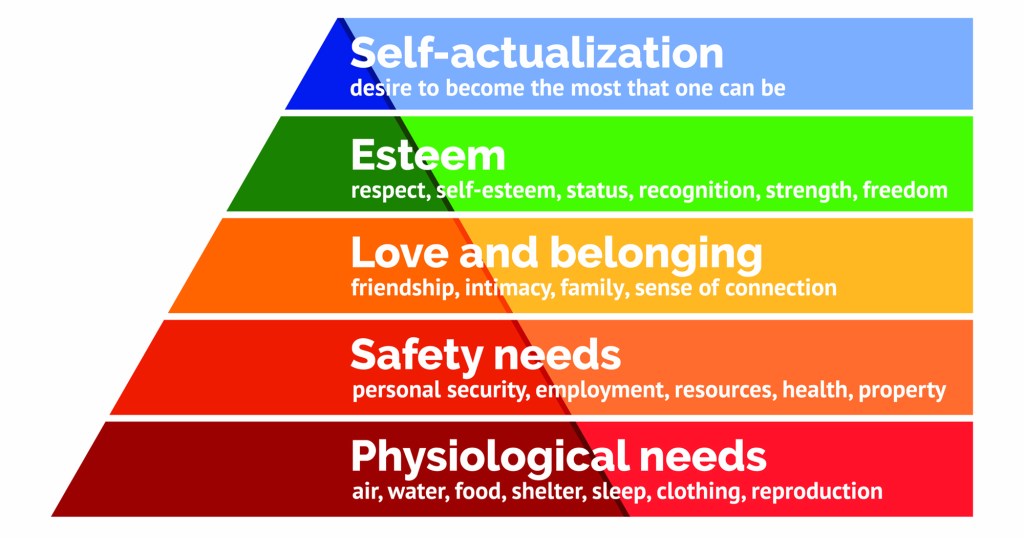
Abraham Maslow (1954), a pioneer of transpersonal theory was one of the first psychologists to cover the necessity for shelter and safety, when he produced his hierarchy of needs model.
Maslow’s Hierarchy of Needs
Maslow suggested a hierarchy of human needs, represented above as a pyramid with the more basic human needs at the bottom. He placed the need for shelter in the first level of the physiological, suggesting that if the most basic level of needs are not met then the individual will fail to desire, or be able to focus impulse upon the higher levels of need.
‘Physiological needs are the physical requirements for human survival. If these requirements are not met, the human body cannot function properly… shelter then provides the necessary protection from the elements’ .
Maslow (1954)
Maslow’s theory was vital for making the basic requirements for human survival explicit, and whilst this work is important for understanding how psychology was beginning to view human needs as the requirement for relative psychic stability, I find it it limited for the kind of inquiry I have in mind regarding Home. This blog will have a focus on the higher level of needs, including a later sixth level of need introduced by Maslow (1996) looking at Self-transcendence, and a desire to unite with that which is beyond the personal focus of deficiency.
So to open up the question of Home more broadly, let’s return to psychotherapy. Psychotherapy pre and post Maslow brought to the fore the more object-relational and attachment theories from the likes of Freud (1919), Bowlby (1973) and Ainsworth (1978).
Attachment theory highlights the importance of primary carers providing us with the appropriate living environments which attachment theorists call the secure base. Psycotherapy sugegsts that our attachments provide a deep and enduring emotional bond that connects one person to another across time and space. And it is this thinking around the secure base that leads me to think about ‘Home’.
Attachment is not always reciprocal of course. One person may have an attachment to an individual which is not always shared. Attachment can also be characterised by specific behaviors in children, such as seeking proximity to the attachment figure when upset or threatened. This should arouse behavior in adults towards their children including responding sensitively and appropriately to the child’s needs. These behaviors appear universal across cultures and therefore provides a robust set of behavioural principles for human science to rely upon. Usin attachement theory we can begin to explain how the parent-child relationship emerges and can influence a human being’s development.
Mary Ainsworth (1978) first used the expression ‘securebase’ to describe the environment created by the attachment figure for the attached person. Jeremy Holmes (1997), describes
‘the essence of the secure base…provides a springboard for curiosity and exploration …when danger threatens we cling to our attachment figures…their presence enables us to work, relax and play – but only if we are sure that the attachment figures will be there if we need them again’
Jeremy Holmes (1997)
Why this feels significant is that it begins to bring understanding to what were previously non-tangible but, vital parts to the importance of a secure Home. It makes explicit the need for a Home to be more than a physical construct of walls and materials, John Bowlby went on to agree that ‘the Home environment needs to be a safe and secure place from which human beings can begin to explore the world from’ . This relational focus suggests that a secure base is provided through a relationship with a sensitive and responsive caregiver who can meet the child’s needs, and to whom the child can turn to as a safe haven.
These relationships serve the same function for adults as for children; and provide Homes which can offer comfort and reassurance, and allow us to operate in the world with confidence. In the words of Bowlby;
‘All of us, from the cradle to the grave, are happiest when life is organised as a series of excursions from the secure base provided by our attachment figures “
This now leads us to the aspect of Mother. Most of us can connect to the idea that ‘Mother’ is a universally accepted symbol and archetype of the primary caregiver. In Jewish culture, Mother is also widely referred to as an exemplary symbol of the secure base, therefore, becoming a place of vital comfort for a nation in diaspora. This endorses Home being something beyond its walls, and in line with Jungian analysis, highlights a symbolic desire to return to Mother as Home, and her archetypal aspects of nurturer and container (Jung, 1991).
A return to Mother as Home becomes interesting because it has been discussed lots in psychoanalytic theory. ‘Womb phantasies’ were of particular interest to Freud (1919) who makes a rather fascinating leap that the most ‘Uncanny’ experience a man can have is one relating to the female and the womb, because of its power to create and comfort. This idea is extended to include what Freud describes as the ‘wish fulfilment’ of returning to the womb as Home (Freud, 1919).
‘This unheimlich place…is the entrance to the former Heim [Home] of all human beings…the place where each one of us lived once upon a time…‘Love is Home-sickness’…whenever a man dreams of a place…and says ‘this place is familiar to me, I’ve been here before’, we may interpret the place as being his mother’s womb or her body’
And so the Mother is a place many people crave a return to, and I too have often thought about returning to this place of deep comfort and absolute dependence. Freud interprets this fascination as humanity’s sense of Home and has certainly paved the way for something symbolic to be explored here. I am inclined to agree that this urge to return to our ‘former heim’ could be viewed as a particularly difficult type of displacement from the womb; however, it could also be symbolic of a spiritual diaspora.
Psychotherapy is now adding to the prism of perspective, and conveying a sense of Home which is far beyond basic shelter, with further discourse bringing the qualities of relationship, and companionship, as well as a longing to be somewhere which is not always tangible.
The literature seems to echo the themes of safety, identity and well-being and when the literature moves beyond the environmental factors the most common discussion is about ‘belonging’. If what is being said across the board is that a sense of Home requires a sense of identity in relation to others, then it goes without saying that only through a respect for boundaries can we begin to relate in a way that is mutually beneficial.
An amalgamation of the traditional and the physiological influences begin to construct a sense of Home as a basic need being met, and then satisfying further needs within the comfort of belonging and the relational aspect of attachment to the people we share our Homes with.
John Byng-Hall (1998) discusses the relational aspect of family within the context of the spatial Home by illuminating the ‘too near-too fardilemmas experienced by family members sharing a Home’. He goes on to quote Schopenhauer’s (1851) porcupine metaphor.
‘A number of porcupines are huddled together for warmth on a cold day in winter… they began to prick one another with their quills, they were obliged to disperse. However, the cold drove them together again, when just the same thing happened. At last, after many turns of huddling and dispersing, they discovered that they would be best off by remaining a little distance from one another’ .
Schopenhauer’s observation is a valuable and succinct metaphor because it begins to name the tension experienced through contact, hence the importance of object-relations theory in psychotherapy (Winnicott, 1965).
When weaving together the essential arguments made through some of the key areas in mainstream psychotherapy we have to consider the importance, of not only securing a shelter that will protect us from the environment, but how we co-exist with other human beings. Maslow was pointing out the need to protect ourselves from Mother Nature, but what psychotherapy has stressed is the significance of creating a Home environment with a chain of stable relationships. Home without successful relationships becomes a place in space and time that can bring environmental disruption with chronic consequences.
What this post has illustrated is that beyond the aspect of shelter there is the further need of well-being, love and belonging which can provide the basis of relative emotional security. Our Home therefore, is not simply a space or a place; it is not merely an object in the world, but a more profound way of knowing, seeing and understanding each other.
This question has been one that has challenged me for as long as I can remember. It has brought with it an unremitting, quandary of psycho-spiritual disorientation which has frequently left me perplexed in my search to understand my being and my place in the world.
Home is one of the rare constructs which each member of the human race can relate to. Every community and culture has some kind of common idea of what a Home represents and whilst this can have strikingly diverse, and material differences, we all seem to share a much more homogenous sense of our Home being a place of shelter and safety.
The most common discourse around the topic of Home amounts to where we are in the world. For most, the combination of finding our space and making it our place is what brings us our sense of Home. Whether we choose a domestic, communal, national or international construct, the notion of Home will initially present itself as a spatial, territorial and material matter.
We are encouraged to embrace a shared perspective that positions ourselves in a structural and earthly sense, but what is happening when one cannot feel at Home no matter where you roam?
Whilst many people have experienced a certain, and somewhat satisfactory, felt sense of Home, some people are still seeking to illuminate the challenge of being unable to define orur connection to a home. Some of us choose the physical and structural perspective of home and some of us choose the psychological and emotional connections we have to home. And of course there will be people looking to the spiritual dimension to assist them for their homes have never had a strong connection with buildings, places or people.
What are the lessons to discover from thinking about Home beyond the material and the philosophical approaches, and can these lessons be applied using psychotherapy?
The research literature tells us that if one is to analyse our sense of Home within the context of a material normative sense then we are talking about the requirement to have a roof over our heads, or our ‘shelter’, as described in Abraham Maslow’s “Hierarchy of Needs” model (1954).
Here are some further considerations that could help us clarify the setting in which this post will discuss Home:
If we are to consider Home as the space that provides shelter and a roof over our heads then some people have never been without a Home
If we are to consider Home as the space we have shared with family, friends and loved ones then some people have never been without a Home
However, if we are to think of Home as the space where we have felt a deep belonging. Then soem people have spent the majority of our lives feeling utterly rootless.
This third statement is where the heart of my post lies and therefore the aim of the post is to try and offer further meaning to the experience of ‘rootlessness’.
The challenge of finding Home has brings three analytically distinct, but substantively interrelated types of discourse which are:
What are the key themes that make up a felt sense of rootlessness?
What are the key themes that have brought us the felt sense of Home?
What has been the cause of a polarity between the feelings of disconnection and connectedness?
Analysis of research data illustrates a sense that this feeling of connectedness and belonging holds the key to a greater sense of feeling ‘at Home’. But belonging and connected to what is what will be of greater interest from a psychotherapist’s perspective.
At the heart of my research there has been a clear suggestion to be looking beyond the layers of our identity, our emotions, our core beliefs and the structural limitations. My research has explored my connection with Home using a process of spiritual discernment to bring the question of Home into clearer focus, and pave the way for a peeling back of many layers of meaning that hold personal and universal significance for the research topic. But how will you define home? Is the physical enough? and if so, why?
Few have ever tried to position their Home because for a large majority its answer seems so obvious. Home is home and it is known. But if home has never truly been known are you prepared to go and find it?
My research on the topic of home has been a deep motivation at the prospect of re-describing the journey Home, and offer an addition to preceding knowledge by, pushing beyond and amplifying a collective maxim of ‘turning inward’. Much like Marco Polo, I may not be the first to travel to the destination, but I can at least leave a detailed chronicle of the the experience, a spiritual “Frau Mauro” map that others who are lost can follow. The map may just provide the breadcrumbs and trail through an unfamiliar forest, but it will certainly set a course where only the brave dare to tread .
Troughout my blog, I will outline much of the written theory on the subject of Home, as I begin to uncover the answer to the question;